F A Q's
Here are some questions we receive
regarding Barbara's work as an
executive coach.
|
|
Executive
Coaching -
Definition
Executive
coaching is a
one-on-one
relationship
between
a professional coach
and a high-level
leader
in an organization
for the purpose of
improved
organizational
performance and
personal
effectiveness.
Goals of
Executive Coaching
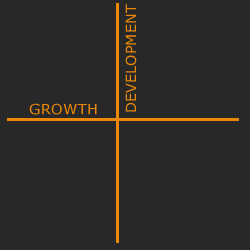
Coaching is either
oriented towards
growth - the
acquisition of skills,
or development -
expanded capacity. The
former is sometimes
referred to as
performance coaching
and the latter
developmental
coaching. Together
they form a horizontal
and vertical axis as
shown in the diagram
below.
I offer both types of
coaching. Increasingly
organizations are
requesting developmental
coaching (while not
necessarily using that
language) because they
need their leaders to
evolve towards later
stages of development to
meet the demands of the
21st century workplace.
Two brief case studies
will further distinguish
between these two types
of coaching.
Executive
Coach Case 1:
Performance
Coaching
This
leader has one
person on his
senior
leadership
team who is
not performing
at the level
necessary to
accomplish a
key strategic
objective. The
leader has
periodically
raised his
concerns with
this direct
report, but
has not
consistently
followed
through on a
development
plan. Our
coaching
relationship
has been
focused on
expanding the
leader’s
coaching and
development
skills. This
includes
exploring his
reluctance to
set clear
expectations,
face conflict,
and hold the
person
accountable.
We have
expanded his
feedback
skills and
practiced how
to hold
difficult
conversations.
Executive
Coach Case 2:
Developmental
Coaching
This
leader has
been
challenged to
“think more
strategically.”
This is
actually a
request for
the leader to
operate from a
later stage of
development.
At the present
time the
leader is
recognized for
her
specialized
expertise. She
prides herself
on knowing the
“right way” to
do things.
Unfortunately,
this is
precisely what
is getting in
her way of
seeing the
bigger
picture. Her
company is
undergoing
significant
organizational
changes and
she is being
asked to build
strategic
alliances and
solve problems
based on the
broader needs
of the
company, not
just the needs
of her
Division. Our
work has
focused on
redefining her
perception of
her role,
strengthening
her capacity
to build
partnerships
across the
organization
and developing
her capacity
to let go of
“her way” in
service of
broader
business
goals.
|
Generalist Approach
Some coaches
specialize in a
particular skill set
such as presentation
skills or sales
skills. I am a
generalist, being able
to work with a leader
on a wide range of
issues from
interpersonal skills
to time management to
strategic thinking to
self-management. My
specialization is in
the process of
learning and personal
change. Leaders
generally know what to
do; the challenge is
executing what they
know. That is my
expertise: helping a
leader identify and
remove the obstacles
that prevent applying
what s/he knows. My
role is to be a
thinking partner, not
an expert with "the
answer."
|
|
|



